

Most office moves that go wrong were not badly executed on the day. They were started too late.
An office relocation in Singapore has moving parts that a home move does not. Building management approvals on both ends, a lift and loading bay you have to book, a fibre line that takes weeks to activate, and staff who still need to work while the plan comes together. Miss one long-lead item and the whole move slips.
This guide lays out the office relocation timeline week by week, from the first site survey to your first working morning in the new premises. Use it to see what has to happen when, what the Singapore-specific approvals are, and where the real delays hide.
How long does an office relocation take in Singapore?
Quick Answer: A full office relocation in Singapore usually takes 8 to 12 weeks to plan and run, from first site survey to the first working day in the new office. A small office under 20 staff can move on a 6-week timeline. A larger move with a server room, a fit-out, or fire safety works needs 3 to 4 months. The long poles are your building’s move-out and move-in approvals, internet and IT provisioning, and any renovation that needs SCDF plan approval. Start those three early and the rest of the move falls into place.
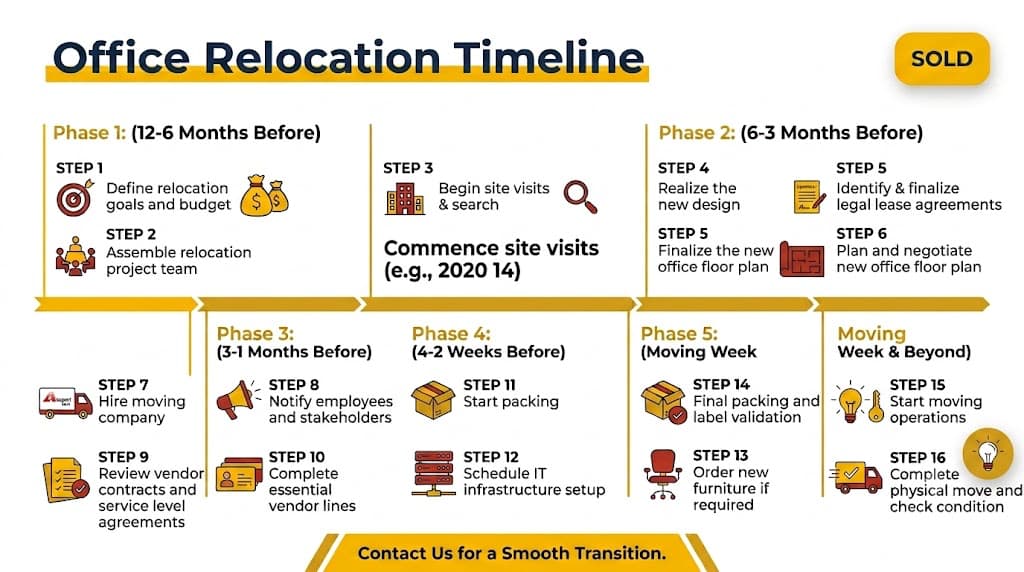
The timeline below assumes a mid-sized office, roughly 20 to 60 staff, moving into space that is close to ready. Scale it up if you are building a new server room or a full fit-out. Scale it down if you are a small team moving desks and laptops into a serviced office.
12 weeks out: survey, budget, and the lease
This is where the move is won or lost. The tasks here look slow and boring, which is exactly why people skip them and pay later.
Book a site survey of both offices. A mover walks the current space and the new one, counts the workstations, meeting rooms, storage, and heavy or awkward items, then checks access at both ends. That survey is what turns a guess into a real quote. Our office relocation team runs the survey free and quotes on what we see, not on a floor count over the phone.
At the same time, lock these down:
- – Confirm your new lease dates and any overlap. A one to two week overlap between the old and new lease is worth paying for. It gives you room to move in phases instead of everything in one night.
- – Set a budget. Include the move itself, packing, any fit-out or renovation, IT provisioning, and a contingency of 10 to 15% for the surprises every move has.
- – Name one move coordinator. One person who owns the whole move and is the single point of contact for the mover, the building managers, and IT. A move run by committee drifts.
- – Check what the new building needs. Ask both building managements for their move-in and move-out rules early. Some require a licensed mover, insurance documents, and a security deposit before they approve anything.
8 weeks out: approvals, IT, and the floor plan
Now you start the long-lead items. These are the tasks with a queue in front of them, so they have to go first.
Order your internet and phone lines. This is the single most common cause of a broken first week. In Singapore every office fibre line runs on the NetLink Trust network, and a business installation at a new address can take several weeks once the provider and the building are involved. Order it now, not after you move. Confirm the activation date in writing.
Start any fit-out or renovation approvals. If you are changing walls, sprinklers, or the layout in a way that affects fire safety, the work needs plans approved by a Qualified Person and submitted to the SCDF. The official SCDF plan approval process sets out what is required, and approvals can take from a few weeks to a couple of months. Landlord written consent comes first, before any permit.
Sign off the new floor plan. Decide where every team, desk, and meeting room goes. Number the desks and rooms so packed boxes can be labelled to a destination, not just a department. A labelled floor plan is what lets the crew place boxes in the right spot instead of dumping everything in one corner.
Plan the IT and server move. List every server, switch, router, and printer with its location. Decide whether the server room moves as-is over a weekend or whether you rebuild at the new site from backups. Either way, the backup runs before anything is unplugged. Heavy racks, safes, and specialist equipment are a separate handling job, which our machinery moving service takes on when a standard office crew cannot.
6 weeks out: book the move and tell your people
Book the mover and confirm the date. With the survey done and the lease firm, confirm your moving date and lock the crew. Peak windows fill early. Month-end and quarter-end are when most commercial leases turn over, so slots go fast.
Book the lift and loading bay at both buildings. Commercial buildings run their loading bays and goods lifts on a booking system, and you usually need to reserve two to four weeks ahead. Ask each building management for the move-in or move-out form, the approved hours, lift padding rules, and the security deposit. That deposit is commonly refundable and runs anywhere from a few hundred to a couple of thousand dollars depending on the building.
Check the loading bay height. Basement loading bays often cap vehicle height at around 2.1 metres, which rules out a standard box lorry and calls for a low-chassis truck. The site survey should have caught this. Confirm it now so the right vehicle turns up.
Tell your staff and your clients. Give staff their new desk location, the moving date, and what they are responsible for packing. Update your address with clients, suppliers, the bank, and government agencies. Order new signage and stationery if you need them.
4 weeks out: pack plan, disposal, and access
Set the packing schedule. Decide what your team packs and what the movers pack. Personal desk items and files usually go to staff. Shared areas, IT, and anything fragile are better left to a professional crew. Our packers and movers service handles the fragile and awkward packing that offices most often get wrong, from monitors to server gear.
Order crates and labels. Reusable plastic crates beat cardboard for an office move. They stack, they protect equipment, and they are quicker to load. Label everything to a numbered destination on the new floor plan.
Plan your disposal. Old furniture, dead equipment, and years of paper do not need to make the trip. Clear them before the move, not during it. Sorting disposal early keeps it off the moving bill and off the critical path on moving day.
Confirm the access plan. Reconfirm lift bookings, loading bay slots, and after-hours approval at both ends. Many commercial moves have to run after office hours or over a weekend so the building’s normal operations are not disrupted. Know your approved window before you commit the crew.
2 weeks out: confirm everything in writing
This fortnight is about removing surprises. Reconfirm, in writing:
- – Moving date, arrival time, and the crew size
- – Lift and loading bay bookings at both buildings, plus the approved hours
- – Internet and phone activation date at the new office
- – Who packs what, and when packing starts
- – The IT shutdown and restart plan, including the backup
- – Any disposal, dismantling, or reassembly in the quote
Do a final walk of the new office. Check the network points are live, the fit-out is finished, and the floor plan still matches reality. Hand every staff member a simple one-page brief: their new seat, what to pack, and what to leave.

Moving week: pack down and shut down
Packing ramps up across the week. Non-essential areas get boxed first, so the business keeps running until the last moment.
The IT shutdown is the careful part. Run the final backup and verify it. Photograph the back of every machine before you unplug it, so reconnection at the new site is quick. Power down and pack the servers last, using anti-static protection, and move them in a controlled way rather than mixed in with the furniture.
Do a final sweep of the old office. Nothing loose in drawers, nothing left in shared cupboards, every box labelled to its destination.

Moving day: run the plan
With the prep done, moving day is execution. Your coordinator is on site to direct the crew and answer questions. One person stationed at the old office, one at the new one, keeps boxes flowing to the right rooms.
Keep the lift and loading path clear at both ends so the crew is not waiting. Waiting time on a commercial move is billed, and a blocked lift is the fastest way to overrun. As boxes land, they go to their numbered spot on the floor plan, which means teams can start unpacking their own area instead of hunting through a pile.
IT reconnects first. The sooner the network, servers, and key machines are back up, the sooner the first morning runs normally. This is where a project-managed move earns its keep: one coordinator holding the mover, the building, and IT to the same schedule, so the pieces land in the right order.
First week after: settle and close out
The move is not finished when the last box lands.
- – Test everything. Internet, email, phones, printers, and access rights. Fix the gaps while the IT team is still on hand.
- – Reclaim your deposits. Book the old building’s final inspection, hand back the keys, and recover both security deposits.
- – Confirm the address change has gone through with clients, suppliers, and agencies, and that mail is redirected.
- – Deal with leftover storage. If your new space is not ready for everything, or you are moving in phases, short-term storage bridges the gap. Our warehouse and storage service holds equipment and furniture between leases so you are not forced to cram everything in on day one.
- – Get staff feedback. A quick note on what worked and what did not is worth keeping for the next move.

Frequently asked questions
How far in advance should I plan an office move in Singapore?
Start 8 to 12 weeks out for a mid-sized office, and 3 to 4 months if you are building a server room or doing a fit-out that needs fire safety approval. The items that force an early start are your internet line, any SCDF renovation submission, and lift or loading bay bookings, all of which have queues in front of them.
What building approvals do I need to move an office in Singapore?
You typically need move-out approval from your current building and move-in approval from the new one. Both usually mean a booking form, proof the mover is licensed and insured, an approved time slot for the goods lift and loading bay, and a security deposit. If your fit-out changes anything that affects fire safety, that needs a plan approved through the SCDF before work starts.
Should we move the office on a weekend?
Usually, yes. Most Singapore office moves run after hours or over a weekend so the building’s operations and your own downtime are kept low. It also gives IT the full weekend to reconnect and test before staff arrive on Monday. Confirm the building allows after-hours access, since not all do.
How do we avoid downtime on the IT side?
Order the internet line early, back up everything before you unplug it, photograph every connection, and reconnect from a documented plan. Move the servers over a non-working window and test the full setup before the first working day. Most downtime on office moves traces back to an internet line that was ordered too late.
Can a mover handle the whole office relocation?
A project-managed mover coordinates the crew, the packing, the building bookings, and the IT handling under one point of contact, so you are not chasing separate vendors. Heavy or specialist items like server racks and safes are handled as part of the same job rather than farmed out.

Three things to take away
An office relocation in Singapore runs on an 8 to 12 week timeline for most offices, longer if there is a server room or a fit-out. The three items that decide whether you hit the date are the internet line, any SCDF renovation approval, and your lift and loading bay bookings. Order those first.
The move itself is the easy part once the approvals, the floor plan, and the IT plan are locked. A numbered floor plan and labelled crates are what let the crew place boxes correctly instead of leaving you to sort a pile.
One coordinator holding the mover, the buildings, and IT to the same schedule is what keeps a move on time. For a project-managed office relocation with one point of contact and a free site survey, talk to Aspect Mover. With 20 years moving Singapore businesses and a Straits Times Best Customer Service award behind us, we plan the move so your first morning in the new office runs like any other.
Recent Comments