

Singapore has over 1.5 million foreign residents. Every year, thousands of expats leave for Australia, the UK, Europe, and the US when their contracts end, families grow, or plans change. Moving overseas is one of the most logistically complex things a person can do. Get it right and you land at your new home with everything intact. Get it wrong and you face customs holds, hidden fees, and boxes that arrive three months late.
This guide covers what international moving from Singapore actually costs, how to pick between sea and air freight, what customs requires, and how to run your move on a realistic timeline. No fluff. Just what you need to know before you book.
What Drives The Cost Of An International Move From Singapore
Quick Answer: Costs vary widely based on destination, volume, service level, and season. Sea freight is typically the most cost-effective option for full-household moves; air freight makes sense only for small or urgent shipments. The only accurate figure is a written quote after an on-site survey. Aspect Movers offers a free survey and quote for your move.
There is no single price for an international move from Singapore. Four things shape the final cost:
1. Volume. Shipping is priced in cubic metres (CBM). A studio fills roughly 5-10 CBM, a 3-bedroom condo fills 20-30 CBM. More volume means a larger container or higher per-CBM charges.
2. Destination. Southeast Asia is the cheapest. Australia sits in the middle. UK, Europe, and the US are at the top end. Longer ocean routes, port handling, and inland delivery at the destination all push the price up.
3. Service level. Door-to-door covers origin packing, both ports, customs, and final delivery to your new address. Port-to-port looks cheaper on paper, but local handling and last-mile delivery are billed separately at the destination and the total usually catches up.
4. Season. June-July and December are peak. Container space tightens and rates rise. Booking 8 to 12 weeks ahead matters more than chasing the cheapest quote.
Other line items that often surprise people include customs handling and documentation, biosecurity inspections at the destination, and any storage required between your Singapore departure and arrival at the destination.
An accurate cost only comes from a proper inventory and survey. Be cautious of any mover quoting a flat rate by phone before they have seen what is moving and where it is going.
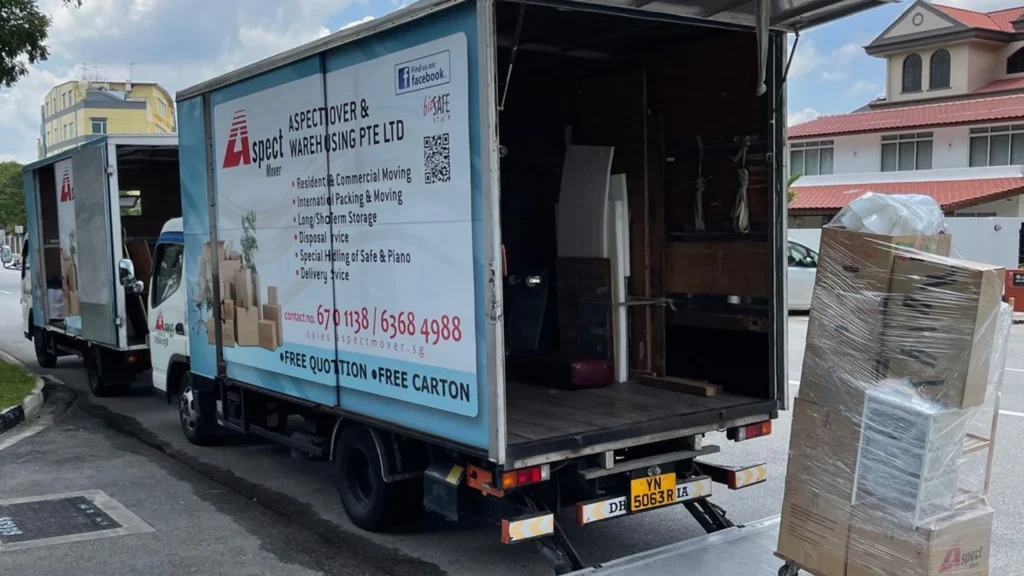
Sea Freight vs Air Freight: What Expats Moving From Singapore Should Choose
The choice comes down to volume and urgency.
Choose air freight if: you are shipping less than 2 CBM, you need items within a week of landing, or you are sending high-value documents and work equipment ahead of the main shipment. Air freight from Singapore takes 3-7 days to most destinations. Per-CBM costs are significantly higher than sea freight, and minimum charges mean even small shipments add up quickly. Use it for a “survival kit” or for items you need urgently.
Choose sea freight for everything else. For a 2-bedroom or larger move, sea freight is the only practical option. Transit times from Singapore by sea:
- Australia: 10-18 days
- UK/Europe: 25-35 days
- USA: 20-30 days
- Southeast Asia: 5-14 days
You have two sea freight options. Full Container Load (FCL) means your goods fill a 20ft or 40ft container alone. Less than Container Load (LCL) means your shipment shares space with other cargo, billed per CBM. LCL is more cost-effective for smaller moves (under 15 CBM). FCL becomes better value once you fill more than half a 20ft container.
The smartest approach for most expat moves is a hybrid: air freight a “survival kit” of clothes, work gear, and school essentials so you are functional on arrival. Ship the rest by sea. This way you are not waiting 3-6 weeks to function at your new home.
The International Move Timeline: What to Do 12 Weeks Out to Moving Day
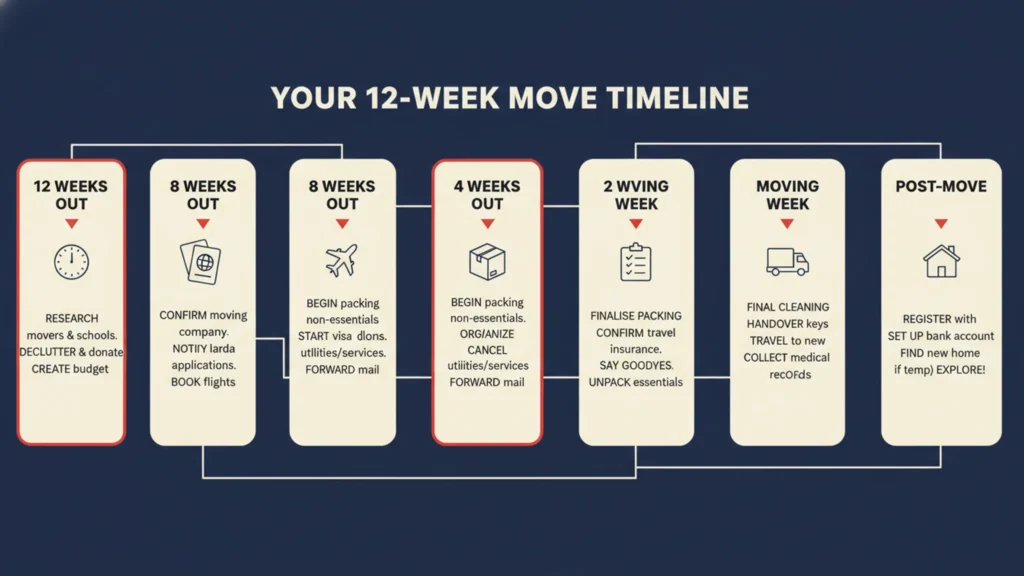
Most expats underestimate how much lead time an international move needs. Here is a realistic week-by-week plan:
12 weeks out:
- Start decluttering. Anything you would not pay to ship, donate or sell.
- Request quotes from at least 3 international movers. Provide a rough inventory and destination.
- Check if your employer covers relocation costs.
8 weeks out:
- Book your mover once you have quotes. Peak season (school year end, December) fills up fast.
- Notify your Singapore utilities (PUB, SP Group) and internet provider of your move date.
- Check destination customs requirements for your specific items (especially if you have a car, musical instrument, or wooden furniture).
4 weeks out:
- Start packing non-essentials: books, artwork, off-season clothes, decorative items.
- Gather customs documents: passport copies, proof of employment or visa at destination, detailed inventory list.
- Confirm your shipping date and container booking with your mover.
2 weeks out:
- Pack everything except daily-use items.
- Prepare your “air freight survival kit” separately if doing a split shipment.
- Confirm customs paperwork is complete and signed.
Moving week:
- Professional crew arrives to pack and load remaining items.
- Hand over Singapore accommodation keys.
- Receive your Bill of Lading (shipping document) from your mover. Keep this safe.
Post-move:
- Track your shipment online.
- Arrange for customs clearance at destination (your mover handles this if you booked door-to-door).
- Confirm delivery date once shipment clears customs.
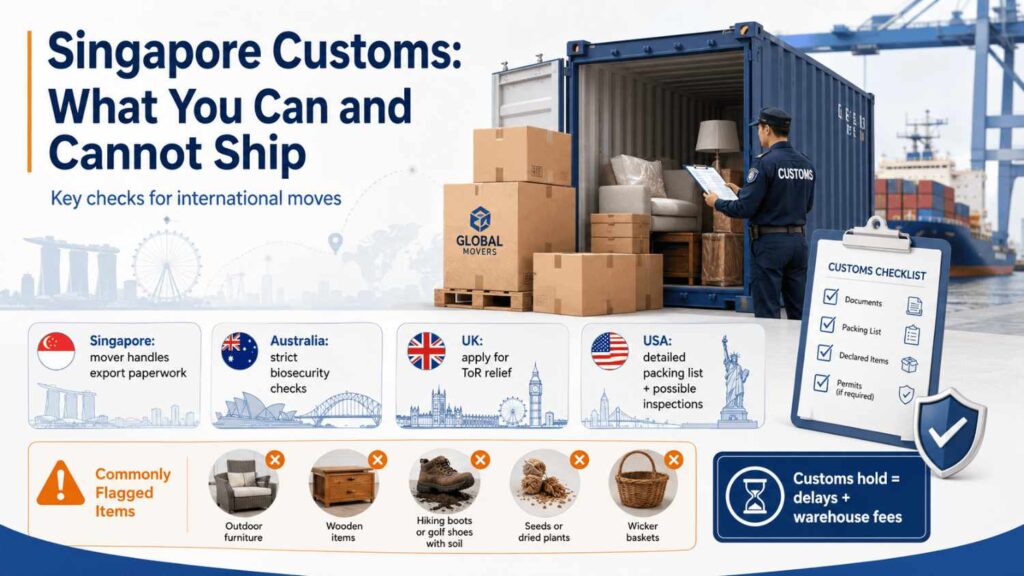
Singapore Customs: What You Can and Cannot Ship
Singapore has relatively relaxed export controls for household goods, but your destination country is a different story.
Singapore export side: Singapore Customs requires a Customs Export Declaration for most commercial shipments, but personal household effects moved by an individual are generally exempted from duties. Your mover will handle the declaration paperwork. Prohibited exports include certain chemicals, wildlife items, and anything on the strategic goods list, but these rarely affect standard residential moves.
Australia – strictest destination: The Australian Border Force runs some of the world’s toughest biosecurity controls. Items commonly flagged and quarantined include:
- Outdoor furniture (especially timber or cane)
- Sports equipment with soil traces (golf shoes, hiking boots)
- Anything made from untreated or raw wood
- Seeds, dried plants, or organic material
- Wicker baskets
All wooden items must be either heat-treated or fumigated before shipping. Your Singapore mover should arrange this, but confirm it in writing before your packing date. Biosecurity inspections at the destination carry fees set by the Department of Agriculture, and the amount depends on the level of inspection required.
UK – post-Brexit changes: UK Transfer of Residence (ToR) relief allows qualifying individuals to import personal household effects duty-free when permanently relocating to the UK. You must apply before your goods arrive. Post-Brexit paperwork requirements have increased, so ensure your mover has current UK customs experience.
USA – CBP requirements: US Customs and Border Protection (CBP) requires a detailed packing list with descriptions, quantities, and declared values for every item. Certain goods (food items, soil, plants, certain wood products) require additional inspection. Build at least 5-7 extra days into your delivery estimate to account for possible CBP inspection delays.
What happens if customs holds your shipment: If your goods are flagged, they go into a customs warehouse at your destination. You pay daily warehouse fees until the inspection is complete, which can add significantly to the total if the hold is prolonged. A good mover will pre-check your packing list against destination customs requirements before the container loads.
How to Choose an International Mover in Singapore
Not all moving companies are the same. International moves involve far more complexity than local removals. Here is what to check before you sign:
Things to verify before you book:
- Registered Singapore business with a physical office address (verify the UEN on ACRA)
- Verified Mover status on independent review platforms
- Cargo insurance included as standard
- A clear, written packing list process
- A real track record on international moves (years in business, client volume, tonnage shipped)
- Industry membership or accreditation where applicable
What a reliable quote should include:
- Packing materials and labour
- Singapore origin port fees and terminal handling charges
- Sea or air freight cost
- Destination port fees and customs clearance
- Inland delivery to your new address
- Insurance coverage amount and what it covers
Red flags to avoid:
- Quote labelled “estimate” with no guaranteed maximum
- No physical Singapore office address (verify the UEN on ACRA)
- No cargo insurance included
- Request for full payment upfront before the move
- Vague or missing packing list process
What Aspect Movers provides: Aspect Movers is based at Mandai Industrial Building, 30 Mandai Estate, with a registered office and warehouse. The team offers both air and sea freight, professional packing, loading and unpacking, plus secure warehouse storage for short- and long-term needs when there is a gap between your Singapore departure and destination arrival. Over 8,000 clients have moved with Aspect Movers, with more than 5,000 tonnes of goods transported.
For a free quote on your international move, contact the team at +65 6760 1138 or sales@aspectmover.sg.
Frequently Asked Questions
How much does international moving from Singapore cost in 2026? It varies widely. The four big drivers are volume, destination, service level, and season. A small Southeast Asia move sits at the low end; a full-household move to the UK, Europe, or the US is at the top end. The only accurate figure is a written quote from a mover who has surveyed your inventory.
How long does sea freight from Singapore take to arrive? Australia takes 10-18 days. UK and Europe take 25-35 days. USA takes 20-30 days. These times cover ocean transit only; add 3-7 days for packing and loading in Singapore, plus customs clearance at the destination.
What is LCL vs FCL for international shipping from Singapore? LCL (Less than Container Load) means your goods share a container with other shipments, billed per CBM. Best for moves under 15 CBM. FCL (Full Container Load) gives you a private container, cost-effective from around 15+ CBM. Most 2-3 bedroom condo moves use a 20ft FCL.
Do I need to declare my household goods to Singapore Customs before shipping? Personal household effects owned and used by an individual are generally exempt from Singapore export duties. Your mover files the export declaration. You need to prepare a detailed inventory list for destination customs.
What items can I not ship from Singapore to Australia? Australia’s biosecurity rules prohibit or restrict untreated timber, cane or wicker goods, items with soil residue (sports equipment, garden tools), seeds, and some food items. Wooden furniture must be heat-treated before shipping. Your mover should handle this but confirm it in writing.
Is air freight worth it for moving from Singapore? Only for small, urgent shipments under 2 CBM, or for a “survival kit” of essentials needed immediately on arrival. For anything larger, sea freight is far more cost-effective. The per-kg cost of air freight is roughly 10x higher than sea freight for the same destination.
Ready to Move Overseas From Singapore?
The most common mistake expats make is starting too late. Book your mover at least 8-12 weeks before your move date, especially if you are leaving in June-July or December, when demand peaks.
Three things to do now:
- Get an inventory count (estimate CBM per room: a bedroom is roughly 5-8 CBM, a living room 8-12 CBM)
- Request a free on-site survey for an accurate quote
- Check your destination country’s customs requirements
Aspect Movers handles international moves door-to-door from Singapore, covering both air and sea freight. Contact the team for a free quote: +65 6760 1138 or visit aspectmover.sg/international-movers/.

Recent Comments